
Reviews & Articles
The origins of Hong Kong's art market & why there are few private museums
John BATTEN
at 2:21pm on 20th February 2026

(This article discusses the origins of Hong Kong's art market and a reminder that the city's art activities can be seen throughout the year - and not only during the yearly art fair activities of March)
Above image: T-shirt by Spike magazine, with printed text first used as a sub-title for its ‘Museum’ (Spring, 2023) print issue (image: Spike magazine website)
The origins of Hong Kong's art market & why there are few private museums
by John Batten
CLOSED
DUE TO
COLONIALISM,
ELITISM, AND A PRIVATE
DINNER
Spike art magazine chose these words as a sub-title for its ‘Museum’ (Spring, 2023) issue, and printed it on a T-shirt.
It’s no doubt inspired by one of the pioneers of text-as-art, the American artist Barbara Kruger, whose words critique the world, especially of power and consumerism. Her epigram, “I shop therefore I am” is probably the best known and joins similar text she has done worldwide in museums, on advertising billboards, and with intentional irony, on tote bags. Following her lead, this style of tongue-in-cheek product (usually by artists or designers) is a staple for edgy art world merchandise - always termed “merch” as if it’s an attitude, rather than just a product.

Barbara Kruger, I shop therefore I am, image sourced from the internet.
Spike is a themed quarterly English-language print magazine with a strong digital presence based in Vienna and Berlin. Its articles cover a range of art topics, accompanied by bright provocative photography, and supported by online articles on fashion, food, cinema, music, design, architecture and urbanism. The key art centres of London, New York, Paris are featured, and the not so obvious, such as Turin in Italy.
It’s a worldly art magazine, so it’s no surprise that Kaitlin Chan, Hong Kong cartoonist and director of Empty Gallery in Tin Wan near Aberdeen, was asked to give her choices for the magazine’s ‘Tops and Flops 2025’ year round-up - IN: “The Darkest Hour at 3am”, exhibition at Current Plans, Hong Kong / IN: Minor Black Figures, novel by Brandon Taylor / OUT: Materialists, film by Celine Song / OUT: Lububu birthday cakes.
Her selection reflects the Spike spirit – a magazine that is variously funny, nerdy, erudite, pretentious, fashionable and always informative of trends and what young people are thinking or doing. This attitude reflects a healthy aspect of the art world: adopting the eclectic, creative and worldly energy of artists. Whereas, too often it is the hype of the art marketplace that gets the mainstream media’s attention: worldwide art auction prices, collectors’ fundraisers, the latest hot artists, big-name gallery gossip, expensive museum acquisitions or daring burglaries, or, March’s one-week buzz around Hong Kong’s Art Basel.
For the other fifty-one weeks of the year, Hong Kong’s artists quietly do their art in studios or other spaces. They organise themselves or join exhibitions with museums, galleries, or independent art spaces throughout the year – invited by curators or gallery owners. The city also regularly sees the work of significant contemporary artists from around the world in the city's international art galleries. Arts writers and critics write about what they see and experience, online or in print magazines and newspapers. Art teachers and their students offer experimentation and assessment when making art. While art historians and museums contribute necessary scholarship and academic enquiry. This art ecology is replicated in any mature city around the world, Hong Kong included.
In essence, it is not dissimilar to the workings of any industry or commercial activity that relies on layers of learning, research, expertise, manufacturing, marketing and sales to prosper and continue. The government’s interest in the “creative industries” and “cultural tourism” acknowledges its niche economic importance for Hong Kong.
The origins of Hong Kong’s art infrastructure began slowly, after 1949 as waves of people arrived in the city at the end of China’s civil war. A regular flow of Chinese antiquities, including rare ceramics, ink paintings and other traditional art or literati objects also arrived in Hong Kong – legitimately or illegally – over the following years from the mainland. Hong Kong’s free port status, minimal taxes, open entry and exit of goods, generally unsupervised money flow, and a no questions asked environment were advantages quickly recognised by the antique market.
Amid Hong Kong’s booming post-war economy, astute buyers began building traditional Chinese art collections – many of international importance. By the 1970s Hollywood Road antique dealers were well-established and international auction houses consolidated the secondary market with their seasonal auctions of important ceramics and ink paintings.
Benefiting from its geographical location with careful purchases and collector donations, the Hong Kong Museum of Art and The Chinese University of Hong Kong’s Museum now have world-class collections of traditional Chinese art and regularly feature superb exhibitions. The Palace Museum at West Kowloon and the Hong Kong Heritage Discovery Centre in Kowloon Park also now mount excellent temporary traditional art and archaeological exhibitions, often working closely with mainland museums.


Two Tang dynasty ceramics figures exhibited at the Hong Kong Discovery Centre, Kowloon Park, Tsim Sha Tsui, 2025 (photo: John Batten)
By the 1980s, Hong Kong’s traditional art market was firmly in place and contemporary galleries began opening, including Galerie de Monde (now known as gdm), Hanart TZ Gallery and Alisan Fine Art; all still going strong. Slowly, auction houses also began offering contemporary art and other collectibles (wine, handbags etc). Chinese domestic art collectors started visiting Hong Kong after the mainland’s economy opened in 1992 and travel was liberalised to Hong Kong in the 2000s. Tapping this new clientele and recognising the city’s advantageous business atmosphere, large international commercial galleries, including David Zwirner, White Cube, Hauser & Wirth and Gagosian all opened galleries, joining Hong Kong galleries with solid and diverse gallery programmes, such as Blindspot Gallery, Kiang Malingue, Rossi & Rossi, Gallery Exit, de Sarthe Gallery and Empty Gallery.

Hong Kong artist Ling Pui Sze's White Mirror - The Vista of Inner Worlds, inkjet print on xuan paper & Japanese paper, bamboo, stainless steel, multi-channel digital video, lava rocks, dimensions variable, 2026. Exhibited at Art Central art fair, 2026. (photo: John Batten)

Hong Kong artist Ling Pui Sze's White Mirror - The Vista of Inner Worlds (detail) (photo: John Batten)
Art Basel acquired the former Hong Kong Art Fair in 2014 to initiate its presence in Asia. Its current global business plan, spearheaded by new majority owner James Murdoch, son of Rupert, is for each of the five current Art Basel art fairs to operate in different physical time-zones around the world. Murdoch is following the Formula One car racing approach: strategically operate races on all continents for a global audience reach. Inevitably, each fair will increasingly cater to a local and regional audience; for example, the new Art Basel Qatar will have a Middle East focus; Art Basel Miami Beach will cater for a South American and U.S. clientele and Art Basel Hong Kong will appeal to mainland, Australia-New Zealand and other Asian art collectors and galleries.
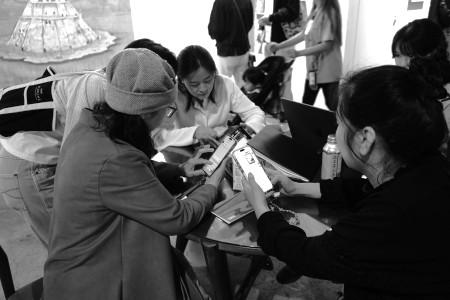
A scene from a booth at Art Basel Hong Kong 2026 (photo: John Batten)
The type of private donor-funded museum or art space that Spike is poking fun at on its T-shirt doesn’t quite exist in Hong Kong, although Parasite and the Asia Art Archive have yearly fundraising dinners. The city's low personal income tax precludes any incentive to make cash donations to a museum. The Leisure & Cultural Service Department Museums, including its Hong Kong Museum of Art; and, university museums, the Palace Museum, M+ and Tai Kwun Contemporary, are either mostly government-funded or receive funds through the Hong Kong Jockey Club Charity Trust (e.g. public losses from gambling). This also explains why Hong Kong has few private museums – there are few tax planning or philanthropic incentives to fund a museum.
However, one example does stand out. The former Nan Fung Textiles factory in Tsuen Wan is one building in a complex of factories built after the 1950s that made Nan Fung the world’s biggest textile manufacturer by the 1960s. In honour of that legacy, the old factory has been expertly preserved and converted as the Centre for Heritage, Art and Textile (CHAT), or Mills6/CHAT. CHAT’s excellent heritage textile and manufacturing displays, art gallery and contemporary exhibitions are funded by a variety of sources: on-site rental income, contributions through the D.C. Chen Foundation, the family foundation of the company’s founder; and, Nan Fung, now a Hong Kong property developer.

Hong Kong artist Sara Tse (front row, fourth from left), with alumni and students singing during the opening of her Woven Campus installation inside the large main hall at CHAT, Tsuen Wan, Hong Kong (photo: John Batten)
The readers of Spike would also be impressed by CHAT's variety of restaurants, organic coffee outlets, funky design shops, craft-making courses, rooftop murals and veggie garden, and a dog-friendly venue where hundreds of dogs and their owners meet on weekends in the main hall.
Tsuen Wan is the sort of off-beat and pre-retro neighbourhood that would happily feature in Spike magazine. Spike, of course, is Snoopy’s brother and the inspiration for the magazine's name – even he, despite living a solitary non-art life in the desert, might like to see other dogs and CHAT’s stimulating exhibitions.
Selected links & information:
Hong Kong Discovery Centre, Kowloon Park, Tsim Sha Tsui
Transport: CHAT and Tsuen Wan can easily be reached by catching the 930X bus that departs from Hong Kong island's Moreton Terrace bus depot directly behind Central Library, then passing through Causeway Bay and Central, arriving near to CHAT. Get off at the very last stop and walk back about 300 metres, past the police station, under the overpass and CHAT is on the other side of Castle Peak Road.
A version of this article was originally published in The Correspondent, the magazine of The Foreign Correspondents' Club Hong Kong, January 2026.